Every empty day costs your landlord money. In 2026, the average void period in England costs landlords £1,135 per vacant property, a 12.9% increase year-on-year, according to Simply Business and Rushbrook & Rathbone. For agents managing portfolios of 50 or more properties, that figure compounds quickly. And with the Renters' Rights Act now in force, void periods are becoming more frequent and harder to predict.
The good news: a significant chunk of those empty days isn't caused by a lack of tenant demand. It's caused by how long it takes to get a listing fully marketed. This guide breaks down what void periods actually cost, why they're getting longer, and how to reduce void periods in lettings by tightening up your marketing window.
Key Takeaways
- Void periods now average 24 days in England, up from 18 days in early 2024. At current rents, that's £1,135 lost per property per void.
- London landlords face the highest outright void cost (£1,252), while the West Midlands saw costs jump 52.9% in a single year.
- The Renters' Rights Act 2025 converted all tenancies to periodic arrangements from 1 May 2026. Tenants can now give two months' notice at any time, making voids less predictable.
- Listings with 3D tours get 87% more views and 95% of prospective tenants are more likely to enquire about a property with a 360° tour.
- Most agencies can compress the gap between vacancy and live listing from seven-to-ten days down to one or two, saving five to eight days per turnover.
How Much Does a Void Period Actually Cost?
The average void period across England costs landlords £1,135 in lost rent, based on a 24-day vacancy at current average rents of £1,438 per month. London landlords face the highest cost at £1,252 per void.
The regional picture tells you even more. According to Simply Business and Rushbrook & Rathbone, void costs vary dramatically depending on where your properties sit and how long they stay empty. That £1,135 figure is before you account for council tax liability, utilities on empty properties, or the cost of re-marketing.
| Region | Average Void Cost | Year-on-Year Change |
|---|---|---|
| England (average) | £1,135 | +12.9% |
| London | £1,252 | Highest outright cost |
| South East | £1,065 | Second highest |
| West Midlands | +£307 increase | +52.9% |
| East Midlands | +£171 increase | +26.2% |
London has the highest absolute cost per void, even though its average void period (16.6 days) is one of the country's shortest. The West Midlands tells a different story: lower rents but a 52.9% surge in void costs, driven by lengthening empty periods. The East Midlands climbed 26.2% over the same period.
For a landlord with three properties averaging one void per year each, the annual cost is over £3,400. For your agency, those empty weeks erode landlord trust. The longer properties sit vacant, the louder the question: should I switch agents?
Why Are Void Periods Getting Longer?
Void periods in England have climbed from around 18 days in early 2024 to 24 days by early 2026, according to the Goodlord Rental Index. Three forces are pushing that number up, and only one of them is about tenant demand.
The Renters' Rights Act changed the rules
The Renters' Rights Act 2025, in force from 1 May 2026, abolished fixed-term assured shorthold tenancies. Every private rented tenancy is now a periodic arrangement. Tenants can give two months' notice at any point. There's no fixed end date to plan around, no renewal window to manage. The House of Commons Library describes it as the biggest reform to the private rented sector since the late 1980s.
For letting agents, this means tenant departures are less predictable. You can't batch your re-marketing around tenancy expiry dates the way you used to. Each departure is a standalone event, and the clock starts ticking immediately.
Tenant expectations for listing quality have risen
Tenants now expect more from a listing before they'll book a viewing. Matterport's research found that properties with 3D virtual tours receive 87% more views and 40% more listing clicks than those with standard photos only. PropertyBox reports that 95% of people are more likely to enquire about a property with a 360° tour. When your listing has four dim photos of empty rooms, prospective tenants scroll past.
This isn't vanity. It's portal performance. Properties that generate more enquiries in the first 48 hours rank higher and stay visible longer on Rightmove and Zoopla.
The scheduling gap between vacancy and "live" is too wide
Most agencies follow a linear process: tenant moves out, property is cleaned, photographer is booked, photos are delivered 24 to 48 hours later, and the listing goes live. At best, that's four or five days. More often, it's seven to ten, depending on photographer availability and cleaning schedules.
On a property renting at £1,200 per month, every wasted day costs the landlord roughly £40. A week of avoidable delay adds up to £280 per void.
How Does Listing Quality Affect Time-on-Market?
Better visuals don't just look nice. They generate more enquiries, attract more qualified applicants, and measurably reduce the number of days your listing sits on the portals.
The data is consistent across multiple sources. Here's how different marketing assets affect listing performance:
| Marketing Asset | Engagement Uplift | Source |
|---|---|---|
| 3D Virtual Tour | 87% more views, 40% more clicks | Matterport |
| 360° Tour Enquiries | 95% of people more likely to enquire | PropertyBox / Property Industry Eye |
| Professional Staging | 73% less time on market vs unstaged | RESA |
| 3D Tour (sales impact) | Up to 31% faster sales, 4-9% higher prices (143,575 listings) | Matterport / Texas Tech study |
The Matterport sales data covers property transactions rather than lettings specifically, and lettings-specific research at this scale remains limited. But the portal dynamics are broadly similar: richer content drives more engagement, and more engagement shortens time-on-market. The NAR 2025 Profile of Home Staging reinforces this from the agent side, with 49% of sellers' agents reporting that staging reduced time on market and 29% seeing a 1% to 10% increase in the dollar value offered.
For letting agents, the takeaway is practical. An unfurnished two-bed flat in Birmingham with four photos of bare magnolia walls will sit longer than the same flat presented with virtually staged interiors, a 3D walkthrough, and a short video. The content doesn't change the property. It changes how many people engage with the listing in the critical first week.
What Slows Down Your Listing Marketing?
The biggest drag on your marketing timeline isn't tenant demand or pricing. It's the gap between a property becoming vacant and the listing going live on the portals. If you manage a portfolio of 80+ properties with typical annual churn, you could be turning over 20 to 30 tenancies a year. Each one needs a full set of marketing assets.
Here's where the time goes.
Photographer booking lag. Most property photographers operate on a 48-hour to one-week booking window. If your tenant moves out on a Friday, the earliest realistic shoot date might be Tuesday or Wednesday the following week. That's four to five dead days before anyone even picks up a camera.
Re-photography costs compound. A professional property shoot typically costs £150 to £400 for a standard package, according to Propelr's UK pricing guide. Multiply that across 25 turnovers a year and you're spending £3,750 to £10,000 annually just on listing photography. That number climbs if properties need re-shooting after a re-decoration or furniture removal.
Empty rooms photograph badly. This is the most overlooked bottleneck. You can get a photographer to the property quickly, but if the rooms are empty, the resulting photos won't perform well on the portals. Bare rooms look smaller, less inviting, and harder for tenants to visualise as a home.
So you either list with poor photos (and wait longer for enquiries) or delay until the property is physically staged (and wait even longer). It's a compounding problem. Each delay adds cost, and the cost of each delay rises with the rent.
How Can You Reduce Void Periods by Shortening the Marketing Window?
Most of the avoidable delay sits between the tenant leaving and the listing going live. By compressing this window, you can recover five to seven days per turnover without spending more on photography. Here's the maths: the traditional linear process typically runs seven to ten days, while the compressed approach below brings it down to one or two.
| Step | Traditional Process | Compressed Process |
|---|---|---|
| Capture photos | Book photographer after vacancy (2-5 day wait) | Photograph during final inspection (day 0) |
| Floor plan | Commission new floor plan (1-2 days) | Use floor plan already on file |
| Staging and tours | Book physical stager or accept empty photos | Generate staged images, 3D tour, and video from existing photos |
| Listing goes live | 7-10 days after tenant leaves | 1-2 days after tenant leaves |
| Days saved | 5-8 days per turnover |
Here are four practical steps to make that shift.
1. Photograph during the final inspection, not after
Most agents already visit the property for a check-out inspection or final inventory. Take listing photos at the same time. You don't need a professional photographer for this stage. A current smartphone with decent lighting produces workable images. Capture one clear photo per room, plus any angles that show layout or natural light.
This eliminates the photographer booking lag entirely. You leave the property with usable images on day one.
2. Keep a current floor plan on file for every managed property
Floor plans rarely change between tenancies. If you have one on file from a previous let, you're already a step ahead. If you don't, capture or request one during the next routine inspection. Many agents overlook this, but a floor plan is the single most useful document for generating 3D tours and helping tenants understand a layout before viewing.
3. Use a workflow that generates tours, staged images, and video from existing photos
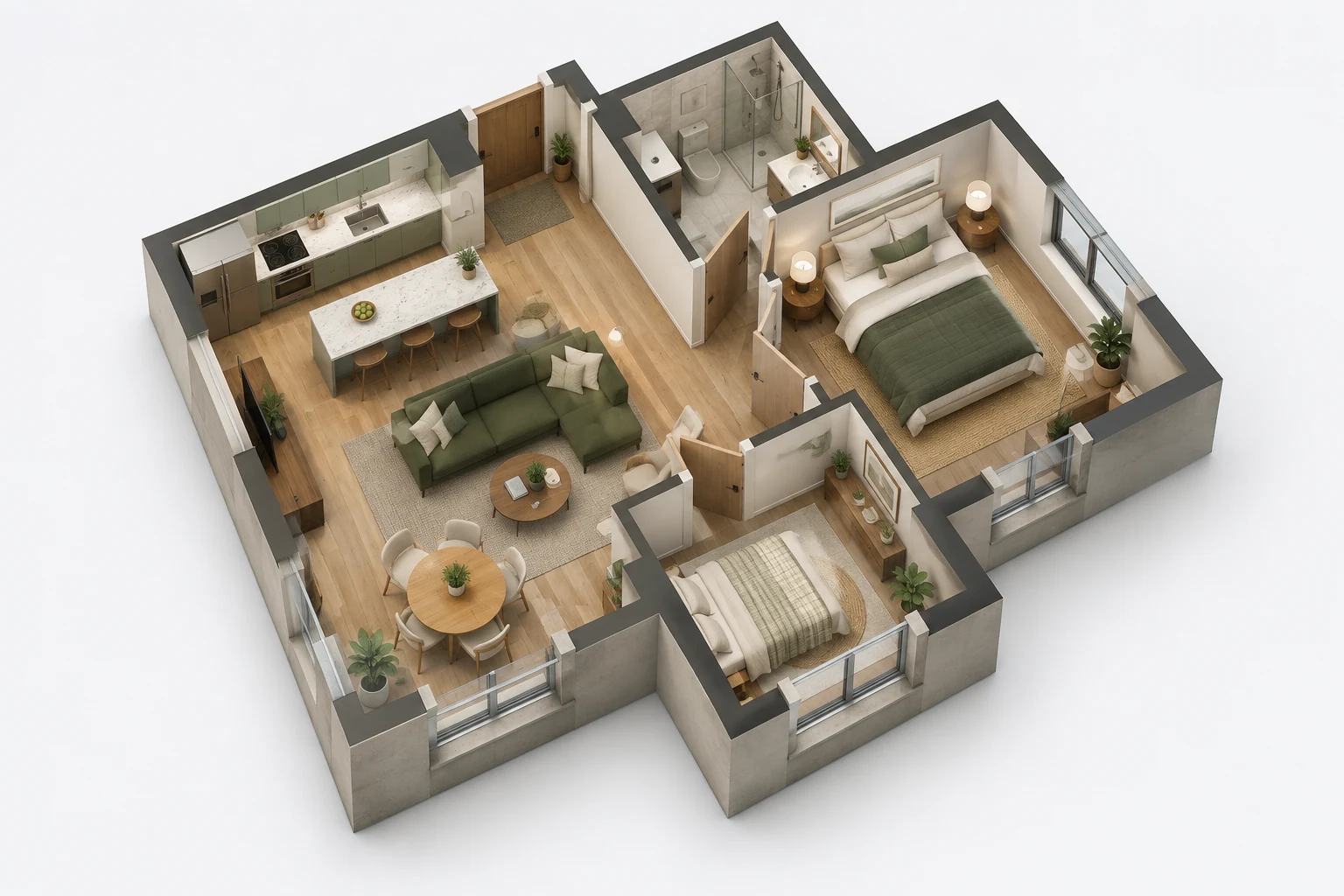
This is where the biggest time saving sits. Instead of commissioning separate shoots for photography, virtual staging, video, and a 3D tour, you can use tools that produce all of these from your existing photos and floor plan. Showhome, for example, takes around one photo per room plus a floor plan and delivers a navigable 3D tour, virtually staged room images, and a property video, all without a return visit to the property.
The point isn't the specific tool. It's the workflow change: capture once, produce everything. That approach removes the dependency on multiple supplier bookings and compresses your marketing prep from a week into a day or two.
4. Prepare portal-ready assets before the tenant departs
If you've followed steps one through three, you can have a complete marketing package ready before the tenant's notice period expires. That means your listing goes live on Rightmove, Zoopla, and OnTheMarket on the day the property becomes available, not five to ten days later.
On a property renting at £1,200 per month, compressing the marketing window by five days saves the landlord roughly £200 per turnover. Across a portfolio of 80 properties with 25% annual churn, that's £4,000 in recovered rent per year. More than enough to justify any investment in faster marketing tools.
How Can Letting Agents Reduce Void Periods After the Renters' Rights Act?
The Renters' Rights Act 2025 removed fixed-term tenancies entirely, meaning tenant departures can now happen at any time with two months' notice. For letting agents, this creates an operational shift: you need to be ready to re-market a property at any point, not just at the end of a twelve-month fixed term.
The Act didn't just change eviction rules. It fundamentally altered how tenancies begin and end. Every assured tenancy is now periodic. There are no fixed terms, no renewal dates, no predictable end points. Propertymark has highlighted the increased importance of professional letting agents in helping landlords adapt to the new framework, and fast, high-quality marketing is a core part of that value proposition.
Agencies that can turn a property around in days rather than weeks have a genuine competitive advantage. When a landlord compares two agents and one says "we'll have it live within 48 hours of the tenant leaving" while the other says "we'll book a photographer next week," the choice is straightforward.
Faster listing marketing isn't just a nice operational improvement. It's now a retention tool. Landlords who see their properties sitting empty for three weeks will question whether their agent is working hard enough. Landlords who see a complete listing go live the day after check-out won't.
Frequently Asked Questions
What is the average void period in England in 2026?
The average void period across England is 24 days, according to Simply Business and Rushbrook & Rathbone (2026). This is up from around 18 days in early 2024, based on Goodlord Rental Index data. Regional variation is significant: London averages 16.6 days, while parts of the Midlands and North run considerably longer, pushing the national figure upward.
How much does a void period cost a landlord?
At current average rents of £1,438 per month, a 24-day void period costs landlords £1,135 in lost rent alone. But the real cost runs higher. Council tax liability on empty properties typically adds £50 to £150 per month depending on the local authority and any empty-property premium. Utility standing charges, insurance on an unoccupied property, and re-marketing costs push the total per void closer to £1,300 to £1,500 in many cases. London landlords face the highest headline figure at £1,252 in lost rent per void, despite shorter average empty periods.
Does virtual staging help rental properties let faster?
Yes. According to RESA data, staged homes spend 73% less time on the market than unstaged equivalents. The NAR 2025 Profile of Home Staging confirms the pattern, with 49% of sellers' agents reporting that staging reduced time on market. While this data comes primarily from the sales market, the principle translates to lettings: better-presented listings generate more enquiries and shorter vacancy windows. Virtual staging is particularly effective for unfurnished rental stock that photographs poorly when empty.
Can I reduce void periods without lowering the rent?
Most void period reduction comes from operational speed, not pricing. Getting the listing live faster, presenting the property better with staged images and tours, and pre-marketing before the tenant departs can all cut days without touching the rent. The comparison table above shows how compressing from a seven-to-ten-day linear process to one or two days saves five to eight days per turnover, worth roughly £200 to £320 on a £1,200/month property.
Do 3D tours make a difference for lettings?
Properties with 3D virtual tours receive 87% more views and 40% more listing clicks than those with standard photos, according to Matterport. PropertyBox reports that 95% of people are more likely to enquire about a property with a 360° tour. For lettings, where tenants increasingly apply without a physical viewing, tours can accelerate decisions significantly. They also reduce wasted viewings by letting tenants pre-qualify themselves.
How does the Renters' Rights Act affect void periods?
The Act converted all tenancies to periodic arrangements from 1 May 2026. Tenants can now give two months' notice at any point, removing the predictable end-of-fixed-term cycle that agents previously used to batch their marketing prep. The House of Commons Library calls it the biggest reform to the private rented sector since the late 1980s. This makes void periods more frequent and harder to plan for, increasing the need for a fast, repeatable marketing process.
Every day between vacancy and a live listing is money your landlords can see disappearing. If you'd like to test a faster workflow on your next turnover, get in touch with Showhome. Send us a set of photos and a floor plan and we'll build the tour.